
"Why have we fasted, and you have not seen it?... Is not this the fast that I choose: to lose the bonds of wickedness… to share your bread with the hungry?" –Isaiah 58:3, 6-7
A new year often feels like a reset—a chance to realign priorities and refocus on what truly matters. As we step into this season, many of us are asking: How can I approach my work with renewed purpose?
Last time, we explored “A New Conception of Work”—how the gospel shapes our understanding of vocation and reminds us that all work, whether creative or practical, reflects God’s providence and love for the world. We talked about valuing every kind of work, recognizing common grace, and resisting the temptation to divide life into “sacred” and “secular.”
Now, as we begin a new year, we turn to “A New Compass for Work.” If the last chapter gave us a new lens for seeing work, this one gives us a new orientation—a way to navigate decisions, pressures, and ambitions with clarity and integrity. It’s about more than ethics; it’s about virtues, wisdom, and the ultimate audience for our labor.

This chapter will challenge us to ask deeper questions:
- What drives my decisions when the rules aren’t clear?
- Who am I really working for?
- How do I stay calm when success feels fragile?
Let’s dive in and discover how the gospel provides not just a story for work, but a compass—a guide that points us toward faithfulness, justice, and joy in every endeavor.
Limitations of Ethics
Many business ethics courses and books argue that if companies simply focus on the bottom line, honesty will follow—because dishonesty eventually ruins profits. But is that enough?
- The Cost-Benefit Trap: If ethics are only about profitability, then when doing the right thing costs money, the temptation to compromise becomes strong. Sometimes the ethical choice will mean losing margin.
- An Example: Imagine someone lying about their current salary to negotiate a higher offer. They justify it because they’ll lose two weeks of vacation. But that small lie erodes integrity, makes future dishonesty easier, and influences others to do the same. It’s a ripple effect.
Christians reject the idea that ethics are merely transactional. We are honest, compassionate, and generous not because it pays off, but because it honors God’s design for life—even when it costs us.
A Different Set of Virtues
Christians share skills and expertise with everyone else, but the gospel equips us with a unique compass:
- Colossians 3:23 reminds us to work wholeheartedly "as for the Lord."
- Integrity means saying what we mean, doing what we say, and following through every time.
Christian faith elevates love to the highest virtue—loving enemies, forgiving persecutors—radical ideas in cultures built on honor and vengeance.
- Relationships aren’t tools for power or wealth; wealth creation becomes a means to love and serve others.
- Love is the building block of reality, shaping how we work and why we work.
A Different View of Humanity
Ethics alone don’t cover life’s gray areas—like which job to take or when to speak up. Wisdom is essential.
Sources of Wisdom:
- Know God personally—not just believe in Him.
- Know yourself—the gospel keeps us from pride or despair.
- Learn through experience—shaped by God’s truth and self-awareness.
Proverbs offers timeless wisdom for relationships, decisions, and temptations. The New Testament adds the power of the Holy Spirit—not as a magical tip generator, but as the One who makes Jesus real, transforming character and giving clarity, humility, and courage.
A Different Audience
Who are you really working for? Most of us live with an invisible audience—parents we want to impress, peers we want to outshine, bosses we want to please, or even our own internal standards. These audiences shape our effort, our stress, and our sense of worth. But Scripture calls us to shift our focus entirely.
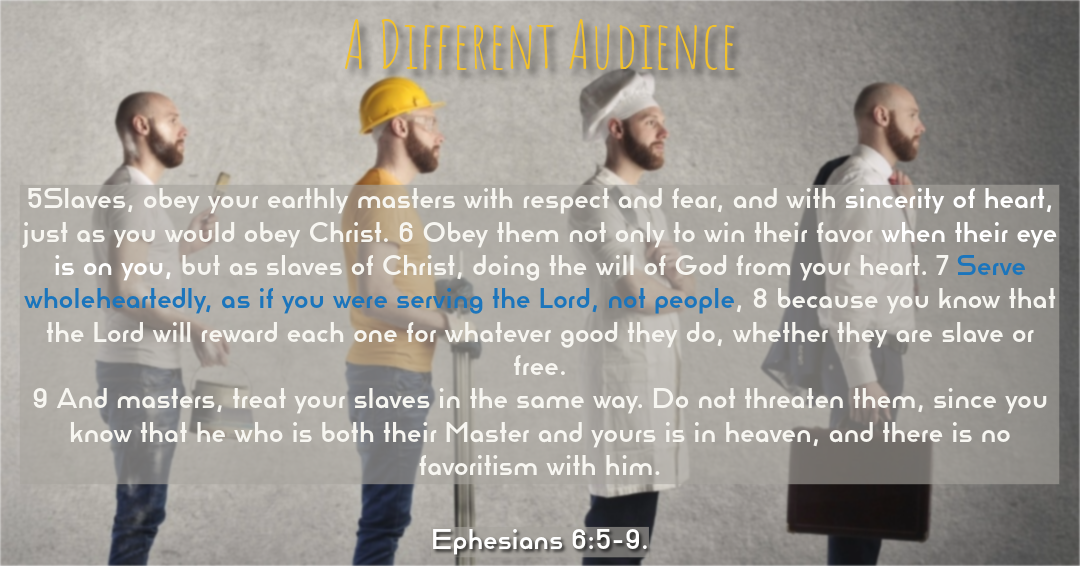
Ephesians 6:5-9 reframes work for both employees and employers:
"Serve wholeheartedly, as if you were serving the Lord, not people."
Paul was speaking to servants and masters in the first century, but his words apply powerfully today. If slave owners were told not to manage through pride and fear, how much more should modern employers lead with humility and care? And if slaves were told they could find meaning and satisfaction in their work, how much more should this be true for employees today?
For Employees
Paul gives four practical instructions:
- Work wholeheartedly
- Not just doing the minimum to avoid penalty.
- Not working hard only when supervisors are watching.
- Not mindlessly or distractedly.
Christians are called to be fully engaged—mind, heart, and body—giving their best to the task at hand.
- Work with sincerity of heart
- This speaks to both focus and integrity.
- Our work must be ethical, not dishonest or duplicitous in any regard.
- Work without eye-service
- Don’t work hard only when being observed or to win favor.
- Excellence should be consistent, whether anyone notices or not.
- Work with Joy
- “Wholeheartedly” includes cheerfulness. Christians can work with joy because their ultimate reward is secure in Christ (see also Colossians 3:23–24).
- Our motivation isn’t tied to salary, recognition, or promotion. We work for the Lord, and that frees us from anxiety about human approval.
For Employers
Paul's words to masters are revolutionary:
“Do not threaten them”
- Employers should never use guilt, fear, or coercion as motivation.
“Treat your slaves in the same way”
- Look for ways to further the interests of those under your leadership, just as they are charged to serve you.
- Invest in their whole lives, not just their productivity.
Remember equality before God
- Paul reminds masters they are slaves too—slaves to Christ.
- God is impartial; class distinctions make no difference to Him. This truth should dismantle pride, condescension, and favoritism in the workplace.
Why This Changes Everything
We all work for an audience, whether we admit it or not. But every human audience is inadequate. Working for them alone leads to overwork or underwork—sometimes both, depending on who’s watching.
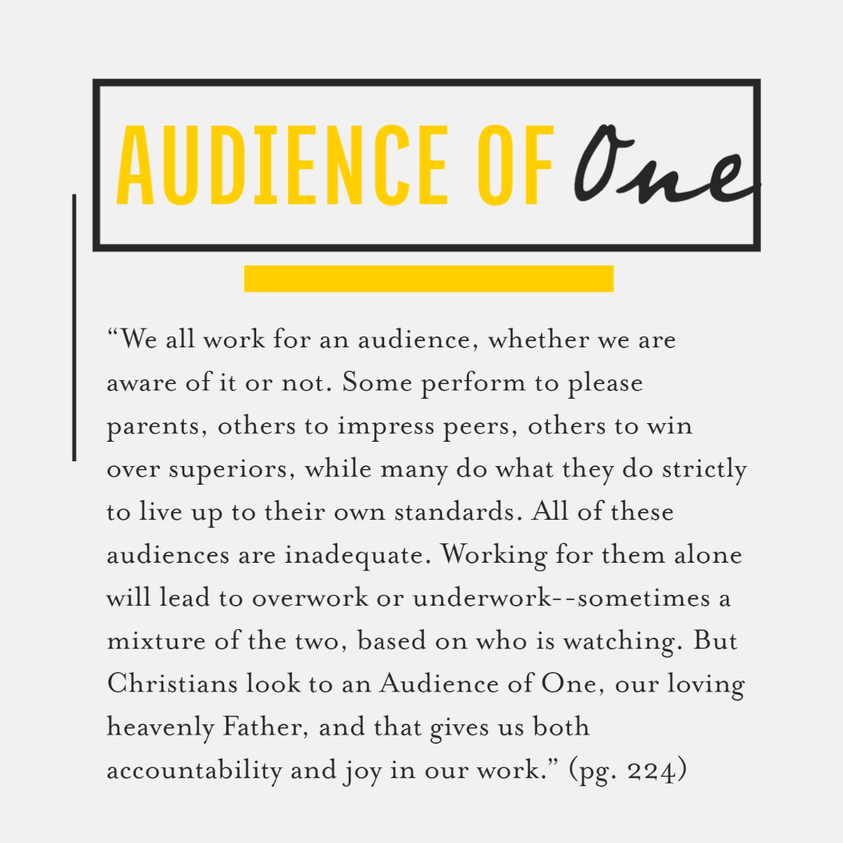
Christians look to an Audience of One—our loving heavenly Father. This gives us:
- Accountability: We work with integrity because God sees everything.
- Freedom: We’re not enslaved to human approval or crushed by criticism.
- Joy: Our identity and reward are secure in Christ, so we can work wholeheartedly without fear.
This shift in audience transforms not only our attitude but our actions. It produces consistency, humility, and grace in the workplace—qualities that stand out in a world driven by performance and comparison.
The Orientation of a New Compass
If Christians live by different virtues, view humanity differently, seek wisdom from God, and work for His approval, what will that look like?
- Fairness and Care: Known for generosity, forgiveness, and reconciliation—not ruthlessness.
- Calm in Crisis: When identity is tied to career, failure brings panic. But if Jesus is your treasure, you have a wealth that cannot be lost (Matthew 6:19–21).
19 “Do not lay up for yourselves treasures on earth, where moth and rust destroy and where thieves break in and steal, 20 but lay up for yourselves treasures in heaven, where neither moth nor rust destroys and where thieves do not break in and steal. 21 For where your treasure is, there your heart will be also.
- Respect for all: Treat those with different beliefs as equals, while remaining unashamed of Christ.
Christian Ethics in Your Vocation
Integrity matters, but Christians must go further—asking:
- How can my field be more just and beneficial to more people?
- Does the structure of my industry align with human flourishing and biblical justice?
You may not have the power to change systems now, but start thinking deeply. When God opens doors, you’ll be ready.
Key Takeaways
- Ethics rooted in profit are fragile; ethics rooted in God’s will endure.
- Love and dignity reshape how we treat people and pursue success.
- Wisdom comes from knowing God, knowing yourself, and learning through life.
- Work for the Lord, not for applause—your identity is secure in Him.
- Engage your vocation thoughtfully, seeking justice and human flourishing.