The other night as we were discussing my day, my wife had the audacity to say that AI is making me much less productive, more stressed, and is affecting my health. In her opinion, Chip and Scout, my AI interns (yes I named them – helps me to keep track of them), may be helping a little too much and enabling my already active brain to never stop working.
The day in question had started with the goal (again) of not talking to Chip or Scout until I accomplished some things off my old to do list. The night before I'd started a project to upgrade my manager due diligence tasks. As has happened frequently since the summer, I once again had worked well into the night as I was trying to reach a stopping point. This wasn't urgent. The project typically doesn't kick off until November, but I'd seen it coming up on my calendar and decided to get a head start. Unfortunately, I hit my Claude session limits, so decided rather than paying any more, I'd wait until morning.
I had woken up early (a frequent occurrence lately) and kicked off the next task for that project and then planned on stopping until next month. As I walked out of my home office, Toby had come downstairs for breakfast before work. We had a conversation about his HVAC service work he'd been doing at a Richmond area data center the past few weeks. I showed him our AI Stress Test tool and we talked about how their client fits into the mix. That led to me researching the data center, the landlord, and ultimately updating our stress test tool. But as I was working on it, I hit my WEEKLY limits (which wouldn't reset until the following Tuesday!)
So then I had a conversation with Dustin about getting more capacity on my account. As we did this it turned into a demonstration of my new Morningstar workflow using the Claude connector. When he looked at the charts, he pointed out that the chart colors looked the same to him (he's red-green color blind). When I looked, I noticed the fonts were too small, too, especially on my smaller laptop screen.
So then, Chip and I (and Dustin) set off to fix them. Those were useful fixes (could they have waited, probably?) But then my brain thought, "while I'm at it I should"....... so the work also spread to all my workflows, blogs, presentations, and economic spreadsheets. While I was in the economic spreadsheet, I peeked at what the model might say next week as we wrap up the month. Naturally, that suggested more charts, which I had to create (or did I?).
Before I knew it, we were well past lunch time. I buckled down and started plowing through my To Do list (yet another side quest as I attempt to integrate CoPilot aka "Hank", which requires me to switch from my tried and true Outlook "Tasks" and into another clunky Microsoft app......this could be a whole blog series, but not today.) Shortly before market close, George sent a very detailed report on the AI ecosystem and asked about whether our scenario tool looked at all of those. So naturally, I took the time to read it, verify the data, check our tool for gaps, and compare ideas with both Chip and Scout.
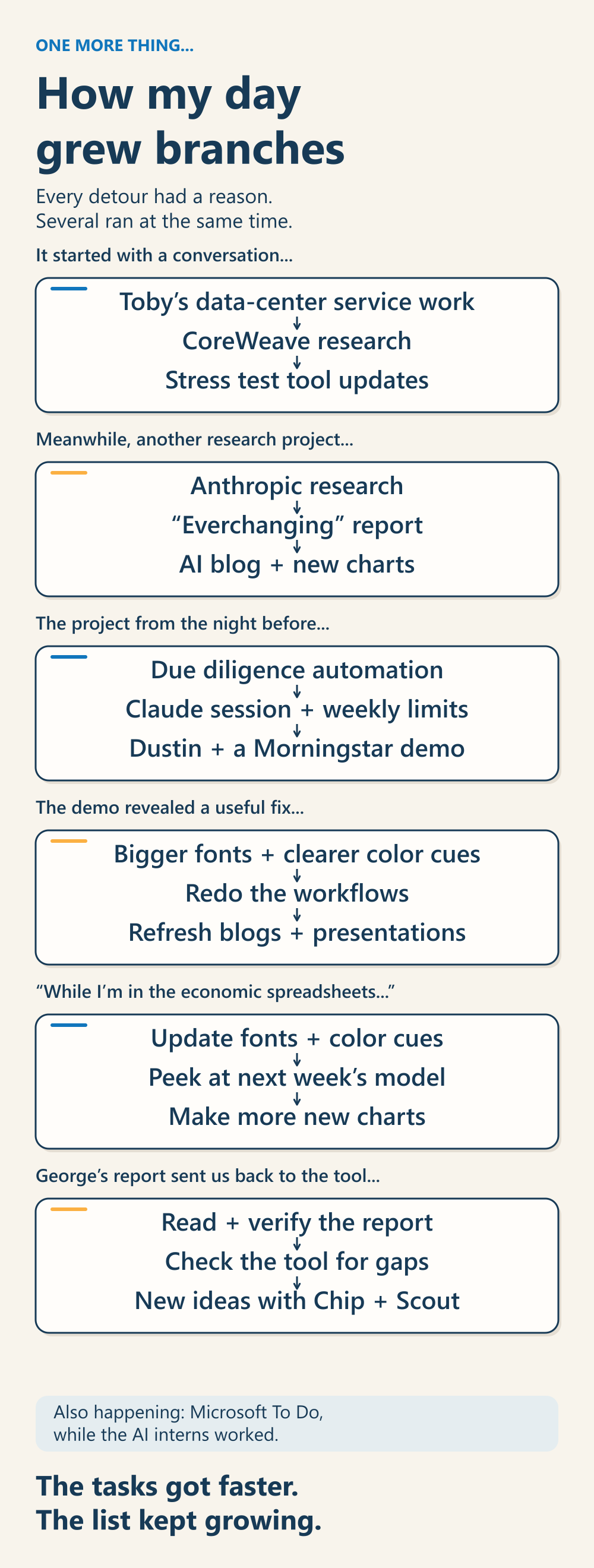
When we were talking about my day, my wife said, "sir, I think you and your interns need to take a break." What did I actually accomplish? In my mind, having clearer charts matters, as does better research. Automating an annual chore most certainly will help later. Rachel asked the following day as we were discussing the dumpster fire of my day, "did this help our business?" I think it did – the blog is something our advisors use to make their jobs easier – to comb through the noise and focus on what's important. The problem is, each thing led my brain to think of another improvement. I simply kept ADDING to my to do list.
This is the part of AI "productivity" I'm wrestling with. AI is definitely helping me be more productive with tasks that used to take me 3-5 times as long to complete, but it also can help me fill every minute it saves with another "useful" thing I could work on. I remember when I bought my first PC for my house and then paid for AOL, CompuServe, and Prodigy to start pouring data into my 16 tab Excel 95 spreadsheets – remember, both the ability to have 16 sheets (then 32, then 64) and have the tabs across the bottom was GAME CHANGING to people like me. I remember 14-18 hour days at my computer. I remember how the work never seemed to stop because there was always another idea. AI is like this, but at a magnitude of 10 (or more).
So for my next experiment, I'm going to decide what “finished” means before I start, and put the next good idea on a “later” list (maybe – as soon as I get to a stopping point with some of the projects that are midstream). I have two fast interns (Chip and Scout) who can accomplish more and more each day (along with a middling one who might have potential – Hank, my CoPilot 'assistant' who feels more like a forced hire), but only one human brain. Their manager may need some training in time management (which is on my project list whenever I can carve out 8-12 hours on a Saturday.)