So, the election is over. What now? Well, there’s a lot to uncover about the election and we can take a lot of points from the results. I think the cool thing about elections, and markets, and other stuff, is you can speculate about them, but you can also get real results to go along with the speculation. There was plenty to speculate about, whether you wanted to use anecdotal data, polling data, history, market movement, and those things could all be used to draw conclusions about what is expected to happen in the election. I had my own share of speculations about what would happen, and I tend to be one where I mostly look at polling data. Yes, I trust polling data, and the polls aren’t usually “wrong”, they’re accurate based on some assumptions, like voting demographics, and they’re usually pretty good at getting margins very close. Yes, even in 2016 this was the case. What these polls tend to struggle with is voter turnout, which you don’t really know how that’ll look until election night.
Typically, Republicans can expect a higher share of the turnout on midterm elections compared to democrats, but there are certain factors that go into this. One main factor is how motivated you are to vote. Generally, the group that opposes the party in charge has more motivation to turn out. We’ll go over the results of this data shortly, but to put it mildly, that was definitely the case in this election.
The funny thing about trying to pick up trends is how quickly those trends can turn sideways in an instant. One of the trends that people have used to discredit polls is how Trump has tended to underperform the polls. Again, this doesn’t mean that the polls have been wrong, they’ve actually been very close. The issue has been in the enthusiasm for Trump’s voter base to turn out for him. That has been the case in every Trump election and midterm during his time in national politics, where his base has really come out to vote. This has led some democratic-leaning races in polls to look closer than we expected. That is a trend that many Republican pundits used to try and have an optimistic view for Republicans going into an election night where the polls were once again returning not in their favor.
The Friday before the election, I gathered the last couple polls that were run and using the average of the credible polls came up with 3 different scenarios for how Tuesday could play out; one with Democrats winning every race where polling had it at 5%, one where Republicans won every race polling at 5%, and one somewhere in the middle where the pollsters picked the winners. Well, this is how the “best-case scenario” for Dems looked according to the polls:
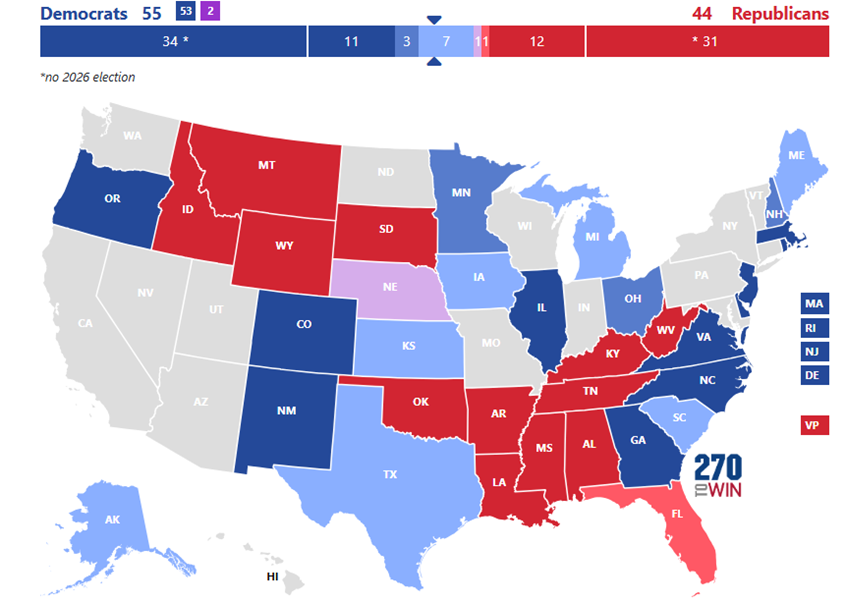
And this is how the map currently stands, pending the results in the uncalled races in Alaska and Mississippi, which both show the challenging Democrats in the lead:
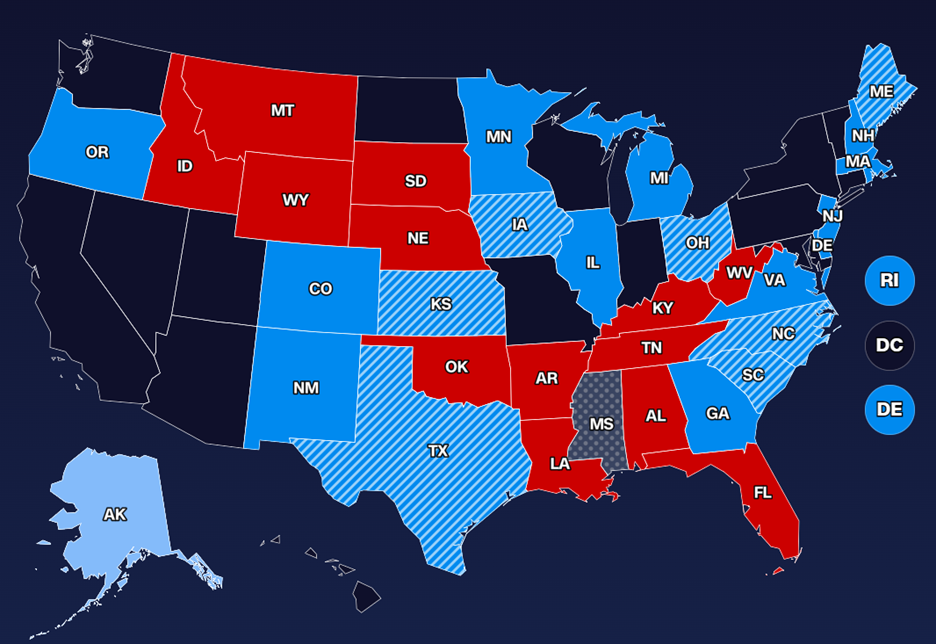
In other words, the polling showed that, if the results in Alaska and Mississippi hold, it’s exactly what the polls indicated COULD be on the table, with the exception of Nebraska which didn’t flip. The Mississippi race didn’t have the best data associated with it, with none of the big, most reputable pollsters gathering data in the state. But internal polling showed that that race being close was also a possibility.
In other words, if you were only paying attention to the polling data, the results were really close to what was expected. The only surprise was the margins, which once again reflect the enthusiasm for voters to vote for Democrats, or in this case, in most cases, to vote against the Republicans and the Trump administration.
It was going to take more than just an exciting candidate or an underwhelming incumbent to make the races in Kansas, South Carolina, and Mississippi close. Trump won Kansas by 16 points, South Carolina by 18 points, and Mississippi by a whopping 22 points. That sort of swing can only happen if A LOT of voters are seeking change.
This is my main takeaway from the election; people were angry with Trump’s actions. The problem with calling it a “blue wave” is it sounds like it was Democrats' actions that convinced voters to vote for them. But polling showed that a lot of Democrats weren’t popular with voters either, they just weren’t as unpopular as the Republicans. The Michigan race was the most interesting about where the appetites of American politics find themselves, where, yes, the far left candidate Abdul El-Sayed won by 7 points in a swing state, but on a national scale, the Dems were favored by about 10 points. So, the best strategy for Dems to gather the most voters was to run a moderate candidate, which is the same thing we’ve seen in the elections since 2016.
No, I don’t think we can expect all races in Mississippi in the future to go blue. This isn’t a shift to the left in the country. It is across the board a rejection of the direction that people think the Trump administration is taking us. The final Kansas poll had Trump’s approval rating at 56% disapproval, to only 40% approval. A whopping 49% polled said they “strongly disapprove”. 81% of those 18-29 in the poll disapproved of the president, 81%!
The shift away from Trump among young voters has come swiftly, as Trump actually performed surprisingly well within that group in 2024. If you go from about 45% approval within that group, to around 80% disapproval in just 2 years, something has gone horribly wrong with that group, and that shift is certainly enough in just that one group to shift the balance of power in the election.
It wasn’t just this group that shifted approval away from Trump. Every age range polled viewed Trump negatively, with the exception of the 65+ age group. Both genders have a negative view of Trump’s handling of the country currently. Every racial group has a negative view of Trump’s handling of the country currently. Polls showed constantly that people did not like how Trump was handling things, and in enough cases, people said their motivation was to vote AGAINST Trump.
Now, Trump wasn’t running, and he made that clear that he wasn’t on the ballot, and if he was on the ballot he would’ve won and won big. This wouldn’t be a wrong assessment if he was merely sitting on the sidelines during these races, but we know that wasn’t the case, because he’s never sitting on the sidelines. He was very active endorsing candidates during the primaries, trying to pick the candidates he viewed were the best. How did he determine this? Mostly by determining the ones who would aid him in his efforts at running the country. The most famous example of this in this election was when Ken Paxton beat incumbent John Cornyn in the Texas primary. Very quickly after that happened, polls indicated that Paxton was incredibly unpopular and that result alone hurt Republican chances in the state. Trump did the same in North Carolina and Georgia, both of his endorsements doing worse in polling versus the Democrat challenger than the other Republican frontrunners. Trump has had a very strong track record in picking the winner in PRIMARY elections, due a lot to his influence within the Republican voter base, but his endorsed candidate have had much worse results in general elections, not just in this cycle, but going back to 2018, 2020, and 2022 as well.
So, yes, Trump’s NAME wasn’t on the ballot, but he made it impossible to ignore him during these elections. The Iran War is incredibly unpopular, and there doesn’t seem to be an end in sight. Trump has since admitted that the Iran War hurt Republican chances this election. The reason why the Iran War has been viewed as unpopular, besides the fact that people don’t usually like the US meddling in international affairs, is because it has affected them HERE. The war has been a contributing factor in raising prices, with inflation being another primary issue during this election. Trump won in 2024 in large part on promises to address inflation, and he has made it worse with this war.
Presidents live by the economy, and they die by the economy. It would be hard enough to maintain power as the party in charge when the economy is stagnant, but when many view it as worse than it was 2 years ago, and those also view it’s in direct result of the President’s actions, then we can expect change. Again, with the exception of a couple economic policies Democrats ran on, there isn’t really anything specific that WON Democrats their races on Tuesday. It is simply that people felt like the Republicans weren’t doing enough with their own policies.
One policy that was popular among voters was a rejection of AI and data centers. This was a plank that Democrats ran on, attacking any Republican who had anything positive to say on the matter. This wasn’t necessarily a major Republican platform issue this election, but one of the most vocal supporters of building out data centers was, you guessed it, Trump. Another indicator that his own actions led to the results of Tuesday.
What impacts will a rejection of AI have on the economy? While the market has broadened, and while the market shot up after the overwhelming result from the election, there’s no way of knowing where the AI growth and boom will head to with a Democratic congress. We know that campaign promises aren’t always set in stone, so what priorities this Congress will have, and what cooperation the president will have in working with them, will have to be seen before we have real answers here.
And lastly, what about the losers of this election? There were a lot of them, and they almost all came from the Republican party. Not just the senate and governor’s races, which almost all shifted to the left, but many state legislatures and senators also shifted Democratic. All the way down the ballot, voters rejected Republicans. The specific thing they rejected is the direction of the country, feeling like things are worse for them because of rising costs. A major contributor to that has been the Iran War, some tariffs and trade war stuff, and some other market-related issues caused by the economic cycle. These things are mostly Trump crusades, not Republican ones. The problem with the landscape that Republicans find themselves in is the monumental power Trump has had within the Republican Party for the last 10 years. Pretty much anybody who has been standing up to him within the party has either left or been removed through primaries. This strategy is confusing for the party, because while he DID win the presidency in 2016, it was a favorable year for Republicans against an unpopular presidential candidate, and it took very slim margins in a few states to pull that off. There was a shift left during the 2018 elections, and then he lost in 2020. Every other time a one-term president has lost, the party has moved on to new candidates in the future, with the exception of Grover Cleveland over 100 years ago, who won the popular vote in his second election.
In the defense of the party, they tried to move past the president after 2020, with a new cycle of candidates to try and prop up. The problem was that the voters within the Republican Party weren’t ready to move past Trump, who remained very influential within his supporters. That group of supporters was enough to carry him forward in 2024, again against an unpopular candidate in a strong environment for Republicans. But the promises he ran on of helping inflation and the economy aren’t being kept. And that was enough to lose enough voters to have the result we saw on Tuesday.
So, he’s a lame duck president in his final 2 years, he can’t run again, and the country has gone to the ballot box to reject his policies.
What will the rest of the party do? More importantly, what will the voters do? Because while those within the Republican party can start moving forward with a new list of candidates to throw their weight behind for 2028, that won’t matter if there is still a large enough group of voters to still allow Trump to have his influence. The best thing for Republicans in the future is the ability to start promising newer, fresher candidates. But if things don’t start to improve here, then the 2026 elections may only be the beginning of a larger shift away from Republicans heading into 2028. I hope we’re now able to enjoy some stress-free holiday time, with cleaner sign-free roads and annoying Christmas commercials instead of annoying political attack ads (I definitely think that’s a massive upgrade). But 2028 election season has already begun.