Trump's Free Money is Real. Your Savings Plan is a Separate Question.
Trump accounts deliver real free money and a long runway for a child's retirement. But for families saving for education, a 529 is still the better tool – and neither one comes before your own retirement. Here's a full breakdown:
Start With The Free Money
Some decisions you need to make are easy ones. In this case, your choice is to either receive $1000 for free or not. There aren’t any strings attached as long as your child qualifies. It’s a pretty easy process too, which I will go over later.
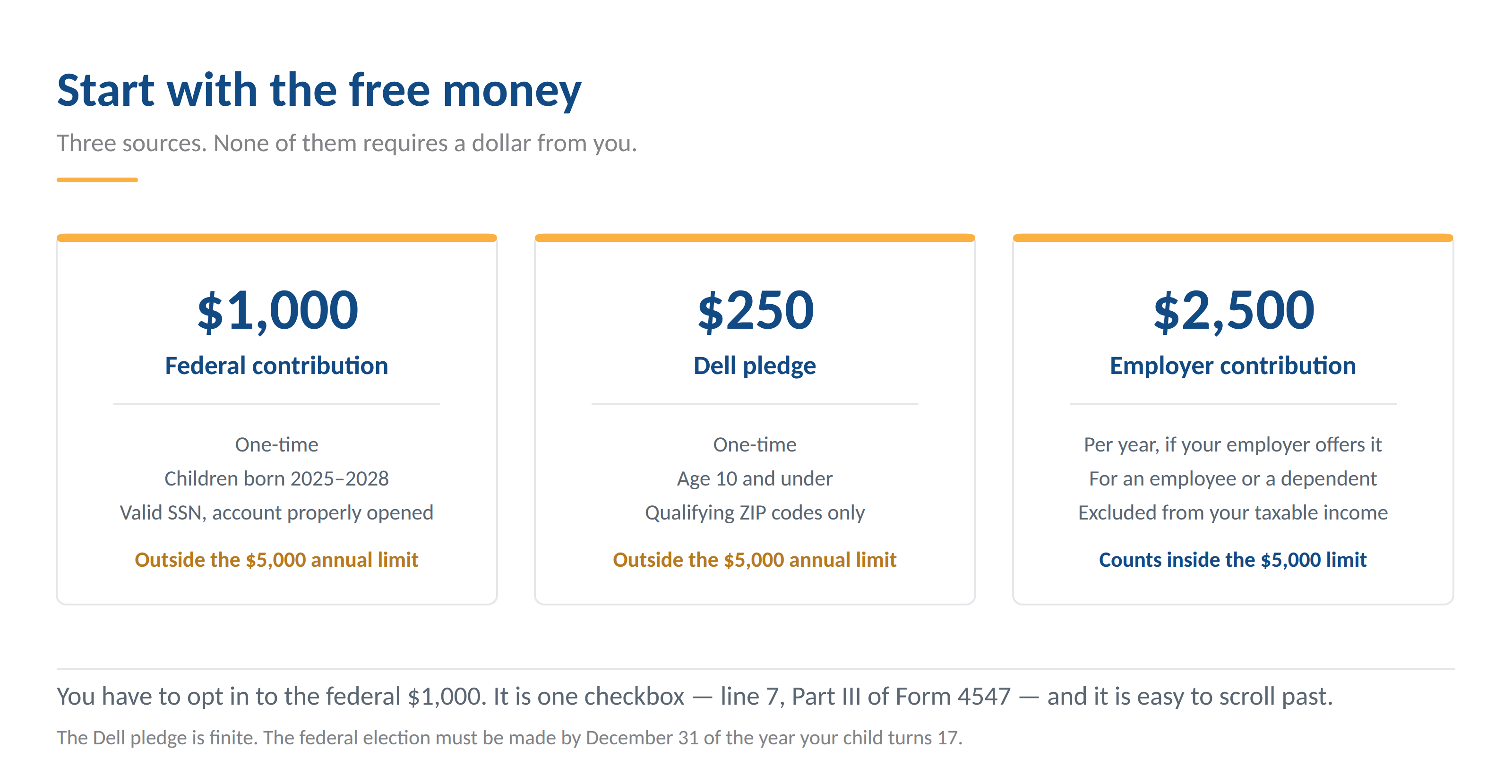
The federal government is making a one-time $1,000 contribution to the accounts of eligible U.S. citizen children born between January 1, 2025 and December 31, 2028 who have a valid Social Security number and a properly established account. That contribution requires no money from you.
Many families also qualify for the Dell pledge, which funds an additional $250 for children age 10 and under (generally those born between 2016 and 2024) living in ZIP codes where median income is at or below $150,000. (You can go to InvestAmerica.org/Dell to see if your child qualifies.) The Dells committed $6.25 billion to reach roughly 25 million children, and the foundation has said children older than 10 may benefit if funds remain after initial sign-ups. Again, no parental contribution is required. Because the pledge is finite, we would rather see families open an account now than wait to see how the numbers shake out.
[Update: Based on reports from clients, the Dell Foundation money was posted to accounts on 9/1/2026. We aren't sure what that means for the timing of accounts not yet open.]
There is a deadline on the federal side too. The election has to be made on or before December 31 of the year your child turns 17, and the $1,000 is only available for children born between 2025 and 2028. One more wrinkle worth knowing (especially if grandparents are asking how they can help): the pilot election has to be made by someone who expects to claim the child as a qualifying child, so opening the account is a parent or guardian job.
Then there is the employer opportunity. Employers may contribute up to $2,500 per year to a Trump account for an employee or an employee’s dependent, and those contributions are excluded from the employee’s taxable income. If your employer offers it, put it in the same category as the federal and Dell contributions: free money.
Open the account. Claim the money. Stop there, for now.
How to Open a Trump Account
There are two paths, and neither costs anything:
- Elect to open an account by filing IRS Form 4547 with your tax return, or start directly at TrumpAccounts.gov. Families of newborns may find much of this handled automatically — the Social Security Administration has begun folding enrollment into standard hospital birth registration.
- Once the IRS processes the election, activate the account through TrumpAccounts.gov or the official Trump Accounts app. You will verify your identity and enter your child’s information exactly as it appeared on the form.
- Watch for the confirmation email, then check that the $1,000 has posted. Contributions default into a broad S&P 500 index fund.
I recently opened these accounts for my two children and from talking to others, your experience may vary. I downloaded the app and it runs fairly smooth. You were able to take care of steps 1 and 2 above at the same time, as Form 4547 can be filled out through the app.
I was able to get notified that the account was opened the next day after verifying my identity, which is very fast compared to some other government stuff. If you submit the form through the IRS website there shouldn’t be any issues filling it out, as it is an easy, 1 page form with very straightforward directions.
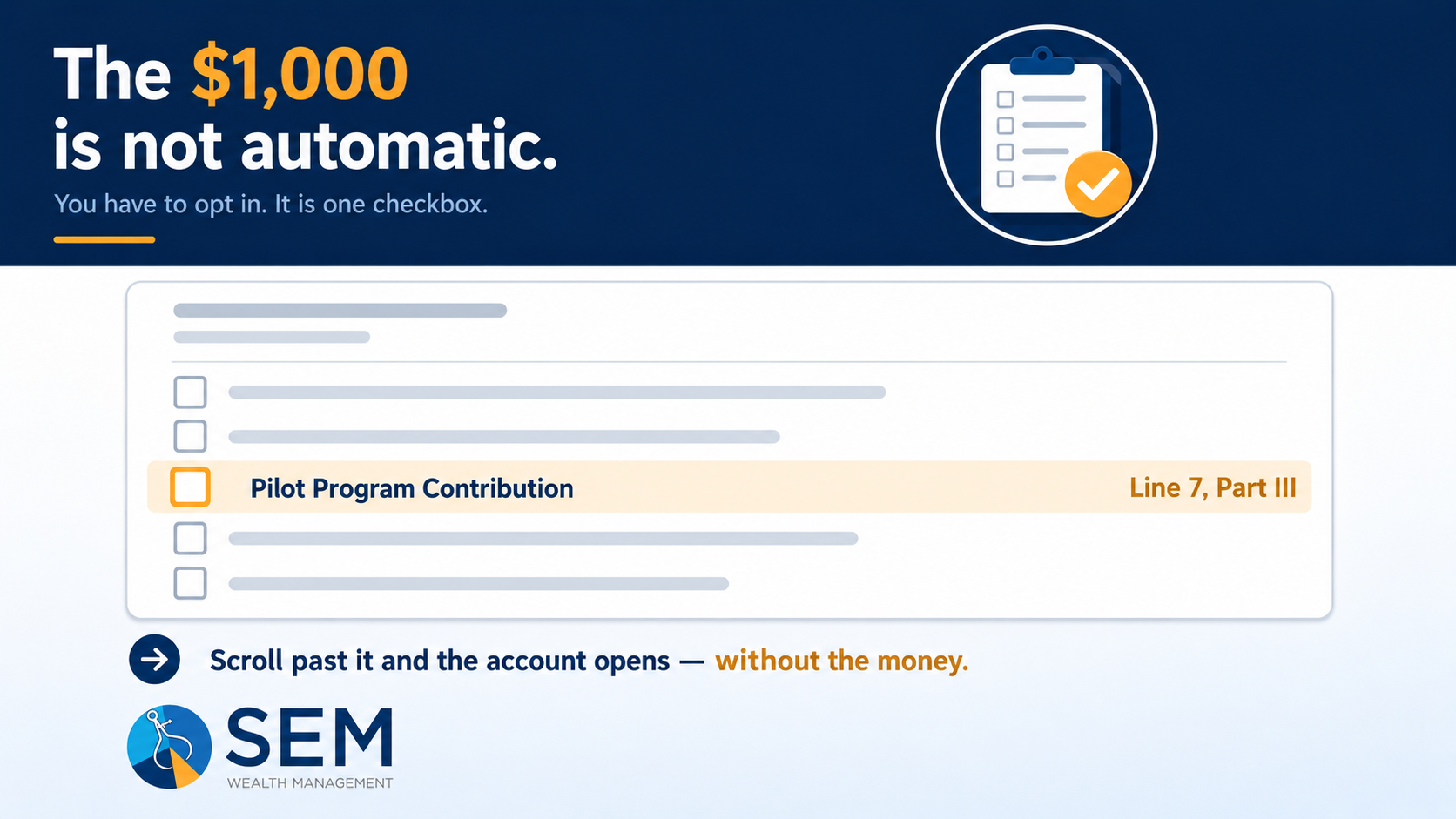
One thing I think should be noted, and I think it is very, very important is you HAVE to opt in to the free $1000 “Pilot Program Contribution”. You don’t automatically get the free $1000. On the paper form it is one checkbox (line 7, Part III), and it is just as easy to scroll right past in the app. So just make sure you’re careful about opting into it. Also, if you’re a website cookies denier, just make sure you’re paying attention!
After completing Form 4547 through the Trump app, it made me verify my identity by taking a picture of a government-issued ID and made me take a couple selfies, which if you know me is something I do not do. The app tried to give you a template to take the pictures, but as you’d guess it didn’t work the best. After a couple of tries, the upload was successful and the account opening was approved. I’m still waiting for receipt of the $1000, however.
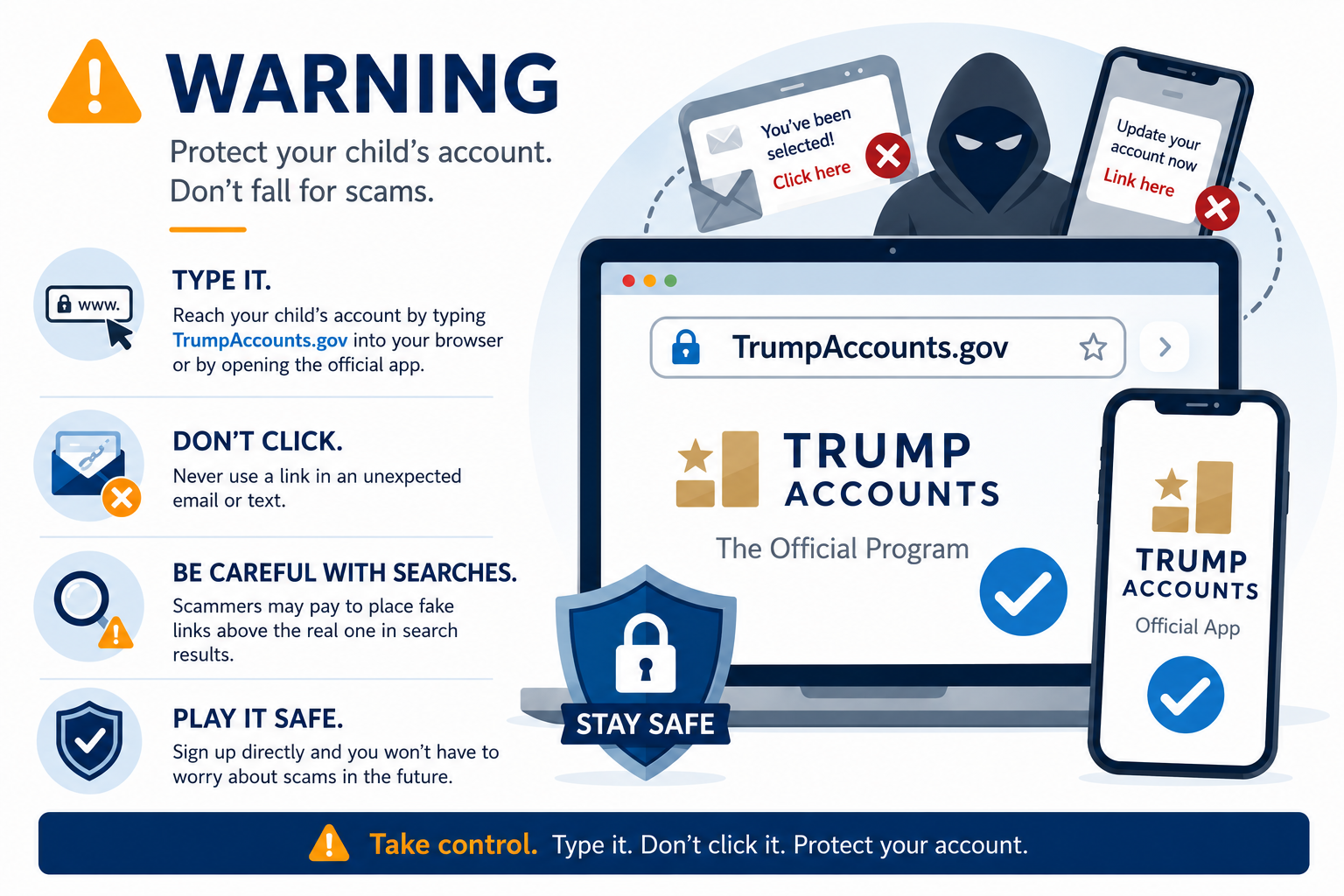
One caution. Programs like this attract scammers. Reach your child’s account by typing TrumpAccounts.gov into your browser or by opening the official app — never through a link in an unexpected email or text. You should even be careful with a Google search as sometimes bad actors may pay to have their link bumped up above the actual, valid link. If you take the time to directly sign up for these accounts, then you won’t have to worry about falling prey to any scams in the future regarding your Trump accounts.
Once you get your account opened, they will advertise ways for you, friends, or family to contribute your own funds into this account. There is a tool with a pretty chart that shows the expected growth of the account at various contribution levels. They make it seem like a no-brainer, but that decision is far more complex than the initial decision you made when you opened the account.
First, the Retirement Dilemma
At SEM we have watched this pattern for decades. Parents cut back on their own retirement savings because they want to help their children. As a parent of two young children, I get it. The motive is admirable. The math usually is not. Your student can borrow for school. No one will lend you money to retire.

And the sacrifice often circles back. A parent who reaches retirement short of resources frequently ends up leaning on the very child they were trying to help. A decision meant to lift a burden off a young adult can end up placing a heavier one on them fifteen years later.
There is a practical wrinkle too. Retirement accounts generally are not reported as FAFSA assets, while traditional college savings vehicles often are. Funding your 401(k) or IRA first is not selfish. In many cases it is the more efficient decision on several key points.
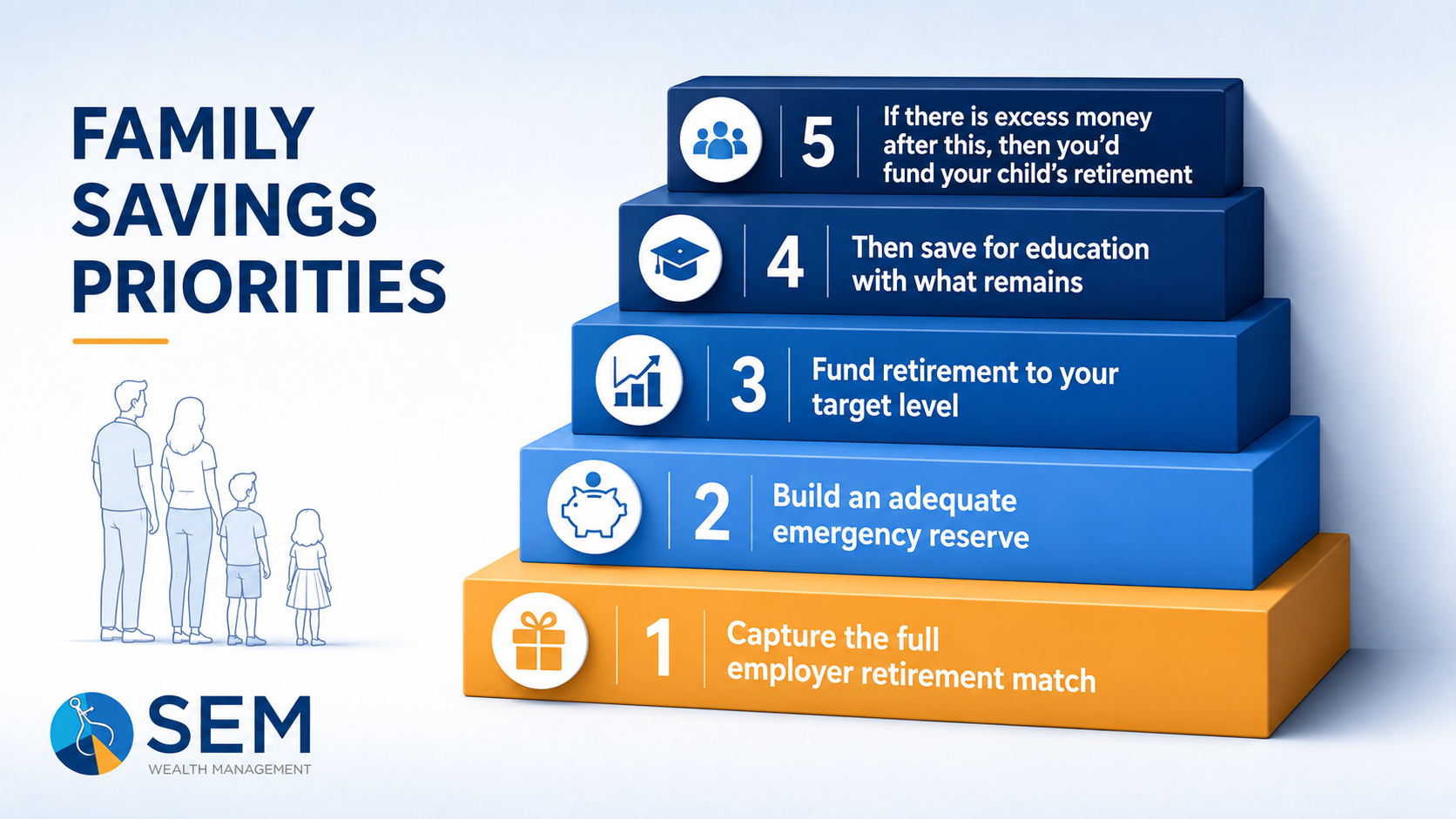
For most families, the order of savings priorities looks like this:
- Capture the full employer retirement match
- Build an adequate emergency reserve
- Fund retirement to your target level
- Then save for education with what remains
- If there is excess money after this, then you'd fund your child's retirement
If you are curious where you stand, we have a free tool at WhatsMyScore.net that allows you to answer some simple questions and will give you tips on the next step based on your personal financial journey.
The reason why you should prioritize your full employer match is the same reason we’re recommending signing up for the Trump account; the employer match is free money to you that wouldn’t otherwise be available in your overall financial picture. Any chance you have to claim free money, you take it. Beyond that, you would like to ensure your money is working to its greatest potential for you. You worked hard for it, make sure it’s being used properly.
One more thing, because this is where people start to panic: your capacity to help pay for education expenses usually grows as you age. Late-career years tend to be your best earning years, and by then a lot of the big expenses (and typically large debts) from your thirties are behind you. That frees up cash right around the time tuition bills show up.
Your kids may hit college age a few years before you feel really ready to write those checks. That's normal, and it's not the whole picture…you may not be the only one at the table (see the “Don’t Forget the Grandparents” section below).
What a Trump Account Actually Is
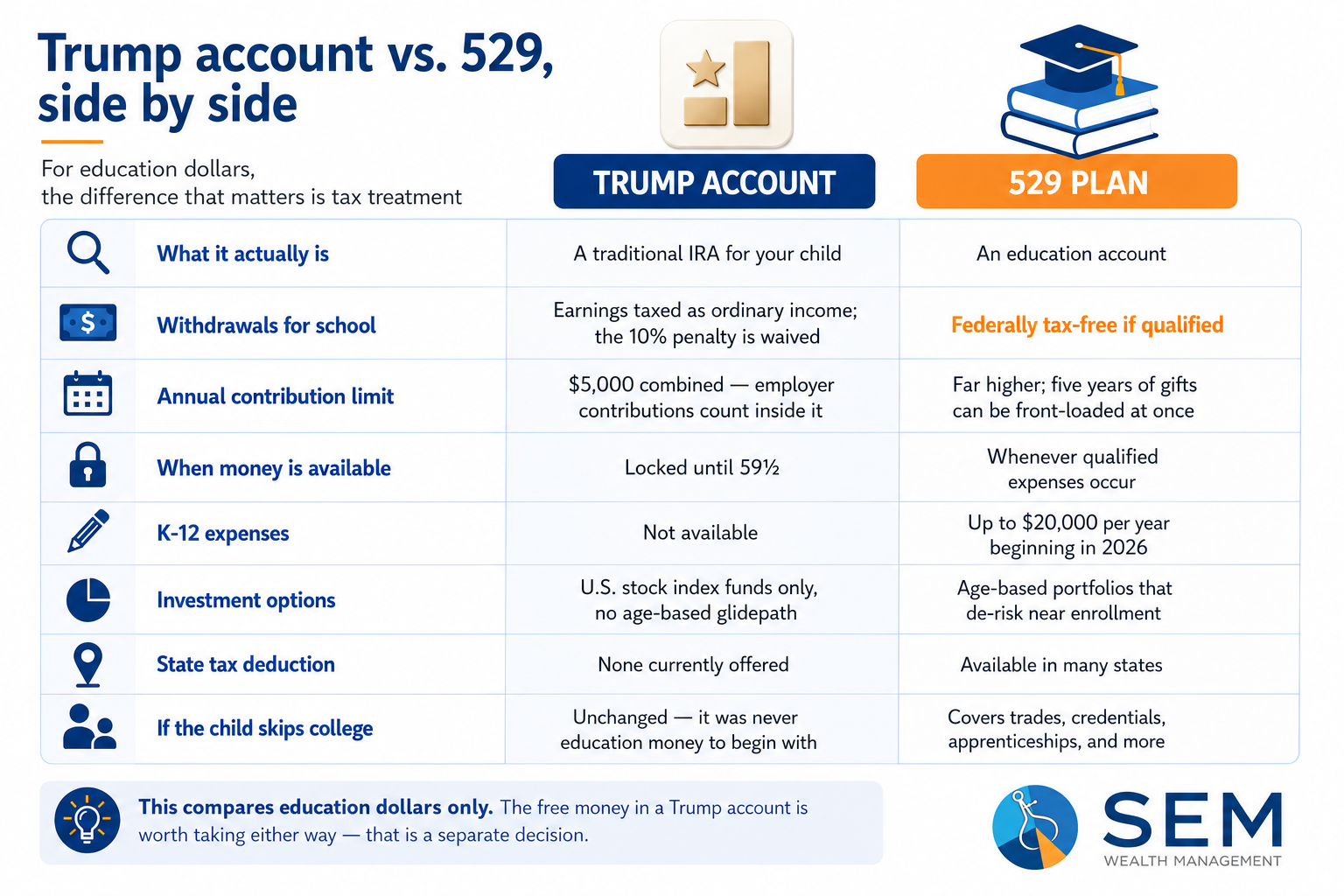
Here is the simplest way to think about it: a Trump account is a traditional IRA with training wheels. It is a retirement account for your child. It is not an education account.
That distinction drives everything else.
During the growth period, which runs from birth through December 31 of the year before the child turns 18, distributions are generally not allowed. The money is locked. No withdrawals for private school tuition, no help with dual-enrollment costs, no assistance with a trade program that starts at 17.
Once the account converts to traditional IRA treatment, qualified education expenses do earn an exception to the 10% early withdrawal penalty. But here is the part most people miss: the earnings are still taxed as ordinary income. The education exception waives the penalty. It does not make the withdrawal tax-free. A Trump account offers tax deferral, not tax-free education dollars.
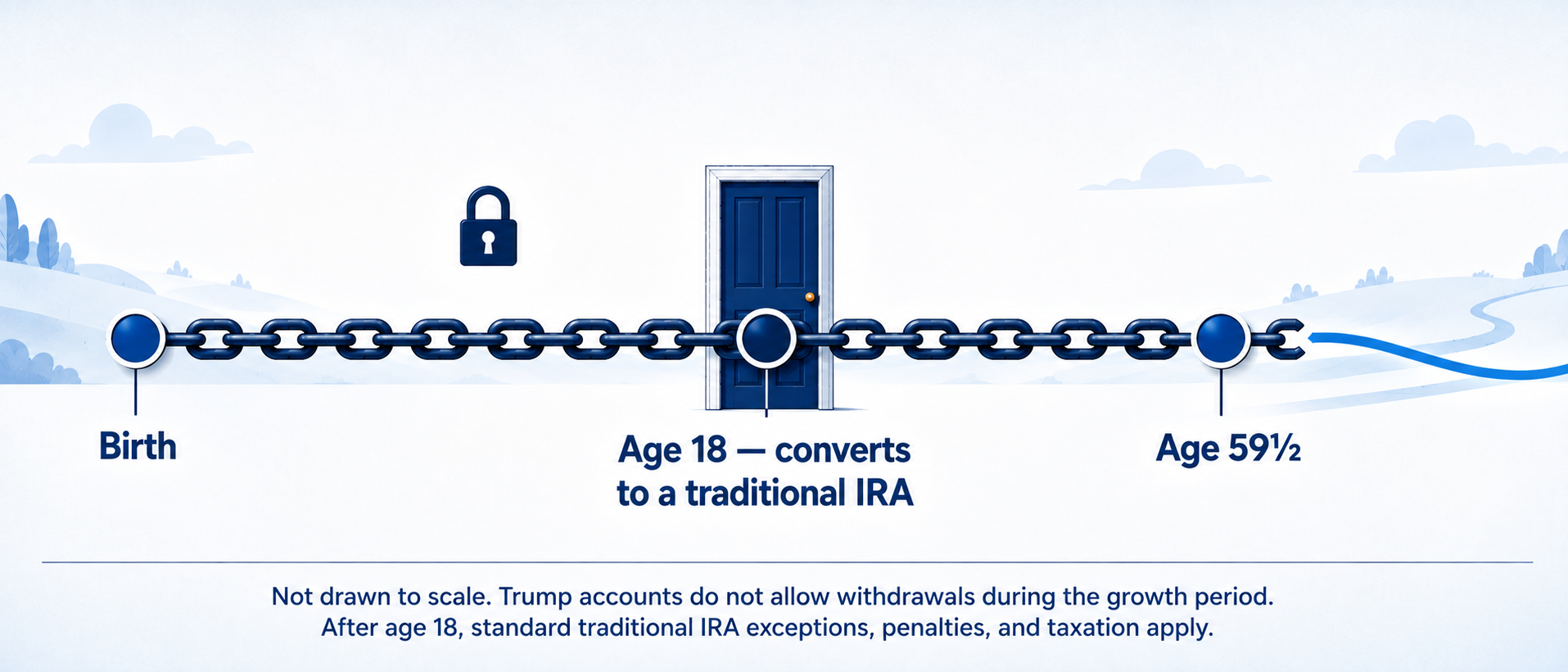
It is also worth being clear about what “converts to an IRA” actually means for your kid at 18. It does not mean the money becomes available. It means the account starts following the same rules as every other traditional IRA, so it is generally locked up until age 59½ outside of the usual exceptions (education, a first home, and a handful of others). If you have been picturing this as money that opens up when they finish high school, it isn’t.
Other limitations worth knowing:
- Contributions are not deductible, and unlike many 529 plans, no state currently offers an income tax deduction for putting money in.
- The annual combined contribution limit is $5,000, with employer contributions counting inside that number. The free money does not eat into it (pilot program contributions and qualified general contributions like the Dell money are not subject to the annual limit).
- Investments during the growth period are restricted to eligible U.S. stock index funds. There is no age-based glidepath, so a 17-year-old two years from tuition is still fully invested in equities, which is something we wouldn’t recommend if the money was going to be used for college.
- Your after-tax contributions create IRA basis that has to be tracked on Form 8606 for decades. Once your child has any other IRA money, withdrawals come out pro rata, which is a recordkeeping headache that lasts a lifetime.
Why We Prefer a 529 for Education Dollars
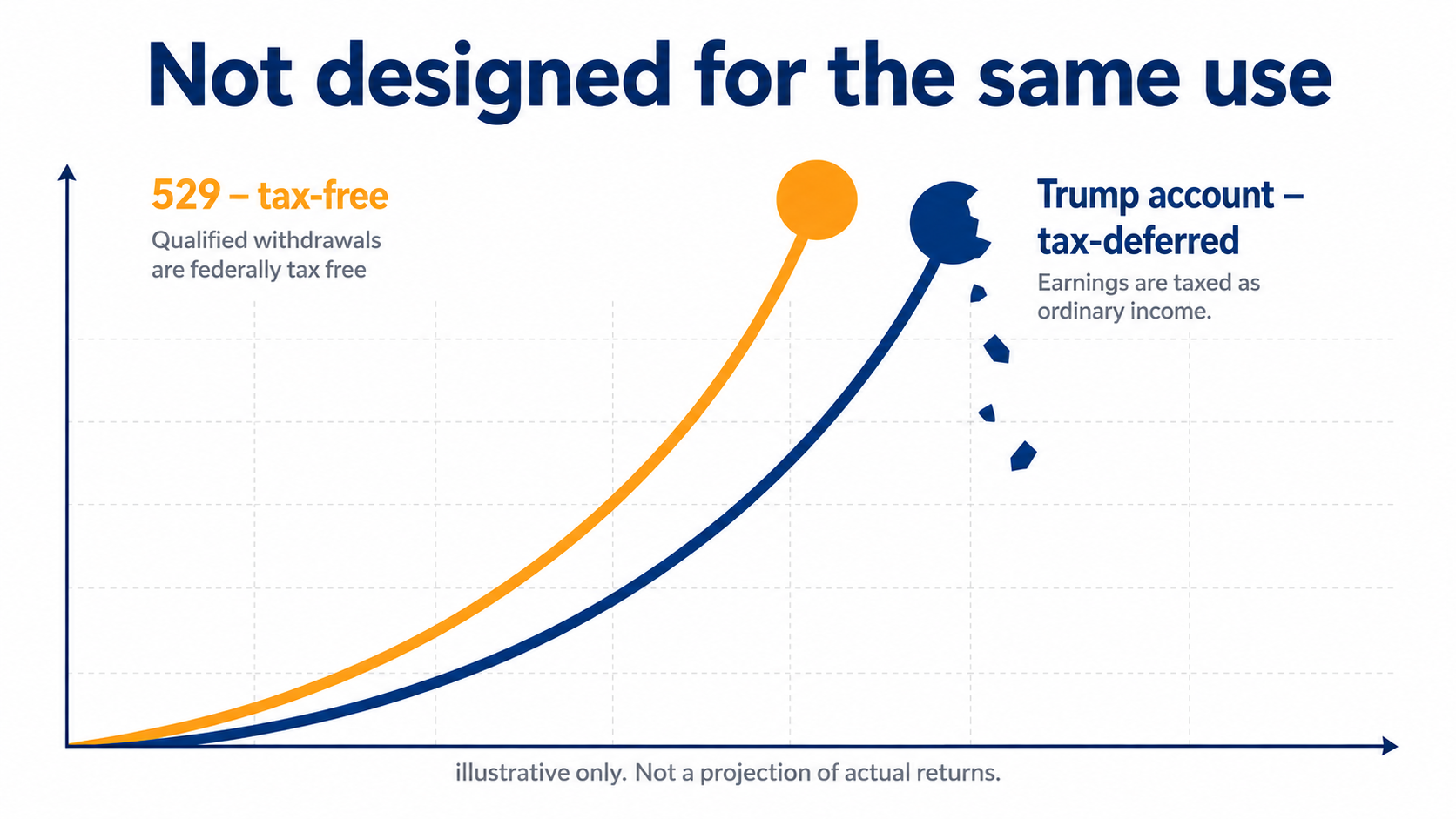
If the goal is education, we think the 529 is still the better tool. And the key difference is not flexibility…it is tax treatment.
Qualified 529 withdrawals are federally tax-free. That is a fundamentally different result than a traditional IRA structure where the earnings eventually become taxable income. Same growth, different ending.
The objection we hear most often is some version of: what if my child doesn’t go to college?
That concern carries far less weight than it did a few years ago. Qualified expenses now reach well past a traditional four-year degree, covering many forms of postsecondary training and credentialing. These can include a CNA credential, a cosmetology license, an ASE automotive certification, a registered apprenticeship, military-related training, and many other career paths. A good education might be a bachelor’s degree. It might just as easily be a trade. And a career path, whatever form it takes, is what ultimately puts a young adult in position to fund a retirement of their own.
The rest of the 529 advantages stack up quickly:
- K-12 withdrawals of up to $20,000 per year beginning in 2026, against an expanded list of qualified expenses that now includes tutoring, curriculum materials, standardized test fees, and dual-enrollment costs.
- Contribution capacity that dwarfs a Trump account, including the ability to front-load five years of gifts at once.
- Potential state income tax deductions or credits for contributions, depending on where you live.
- Age-based portfolios that grow more conservative as enrollment approaches.
- Continued control by the account owner, and the ability to change the beneficiary to another qualifying family member.
One caveat: not every state conforms to every federal 529 expansion, including some of the K-12 and credentialing provisions. Check your own state’s rules before you count on them.
Don't Forget the Grandparents
When I build plans for people near or in retirement, one of the first things that shifts is how they spend. They've got more time, and a lot of them start pointing money at the kids and grandkids anyway. I'm not going to wade into anybody's family dynamics, but a lot of grandparents don't know a 529 is even an option for them or they’ve heard it was a “bad idea.”
It's worth knowing, because the rules recently moved in their favor. Grandparent-owned 529s used to carry a real penalty: the assets weren't reported on the FAFSA, but distributions counted as student income and could cut an aid award by up to 50%. The simplified FAFSA removed that question. Those distributions are now invisible to the federal aid formula, which makes a grandparent-owned account one of the most aid-efficient ways to save.
Ownership is what matters here. The grandparent opens the account and names the grandchild as beneficiary. If you contribute to the 529 account the parents opened instead, it goes back to being a reportable asset.
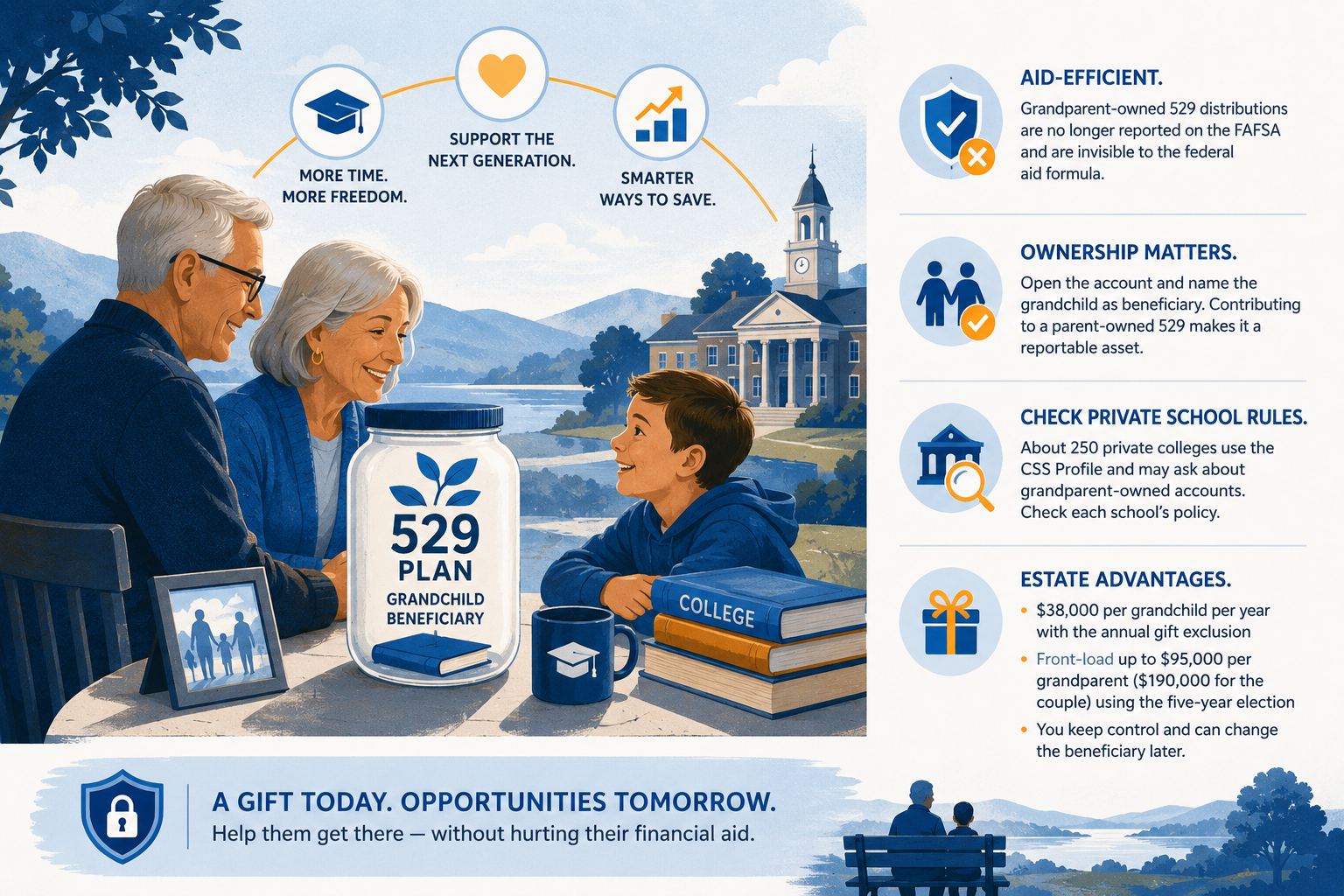
One exception to keep an eye on. Roughly 250 private colleges use the CSS Profile to award their own institutional aid, and many of those still ask about grandparent-owned accounts. If private schools are on your student’s list, check each school’s policy before anybody writes a big check.
There's an estate angle too. Contributions count against the annual gift exclusion, so a married couple can move $38,000 per grandchild out of their taxable estate each year, or front-load up to $95,000 per grandparent ($190,000 for the couple) using the five-year election. The grandparent keeps control the whole time and can change the beneficiary later. For anyone uneasy about handing a nineteen-year-old a large check, that combination is hard to beat.
About That Escape Valve
The most-cited argument for funding a 529 aggressively is the Roth IRA rollover. It is a useful feature. It is not unlimited, and it can be oversold.
The rollover is capped at $35,000 per beneficiary over a lifetime. The account must have been open at least 15 years. Contributions from the prior five years, and their earnings, are excluded. Each year’s rollover is limited to that year’s Roth IRA contribution limit, and the beneficiary needs earned income to receive it. The IRS also has not resolved whether changing the beneficiary restarts the 15-year clock.
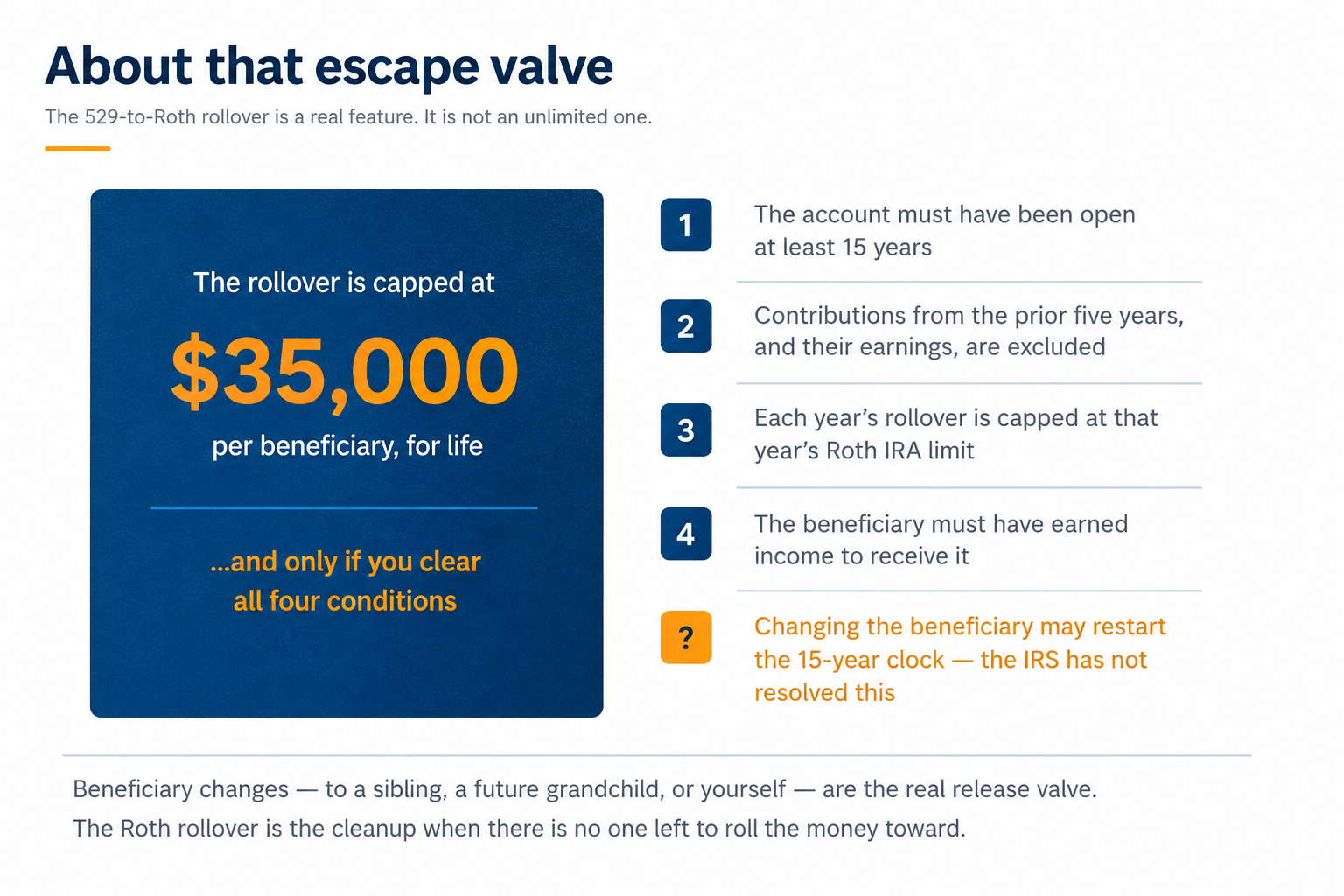
In practice, beneficiary changes, whether to a sibling, a future grandchild, or yourself, are the real release valve for a large unused balance. The Roth rollover is a cleanup if there are no children or grandchildren to roll the money towards. And money that ultimately comes out for non-qualified purposes faces ordinary income tax and a 10% penalty on the earnings, plus possible state recapture.
A 529 does not magically turn unused money tax-free. It just gives you considerably more ways to help your child (or grandchild) start off on solid financial footing.
A Fair Word for Trump Accounts
There are situations where these accounts earn their keep.
Employer contributions are genuinely valuable and have no 529 equivalent (pre-tax dollars from someone else’s pocket). Retirement accounts are not FAFSA-reportable assets, which can help on paper, though that advantage largely evaporates if the money is actually distributed for college, since the resulting student income is assessed far more heavily than the asset would have been. (This is not the same situation as the grandparent 529 above. That change removed a question about untaxed cash support. A Trump account distribution is taxable income, so it lands on your child’s tax return and the FAFSA picks it up from there.)
And for families who have already funded education adequately (and their own personal retirement), seeding a child’s retirement at birth with a sixty-year runway is a perfectly sound objective. For long-horizon money like that, a Trump account also compares well to simply piling assets into a taxable custodial account.
How We Think About Trump Accounts
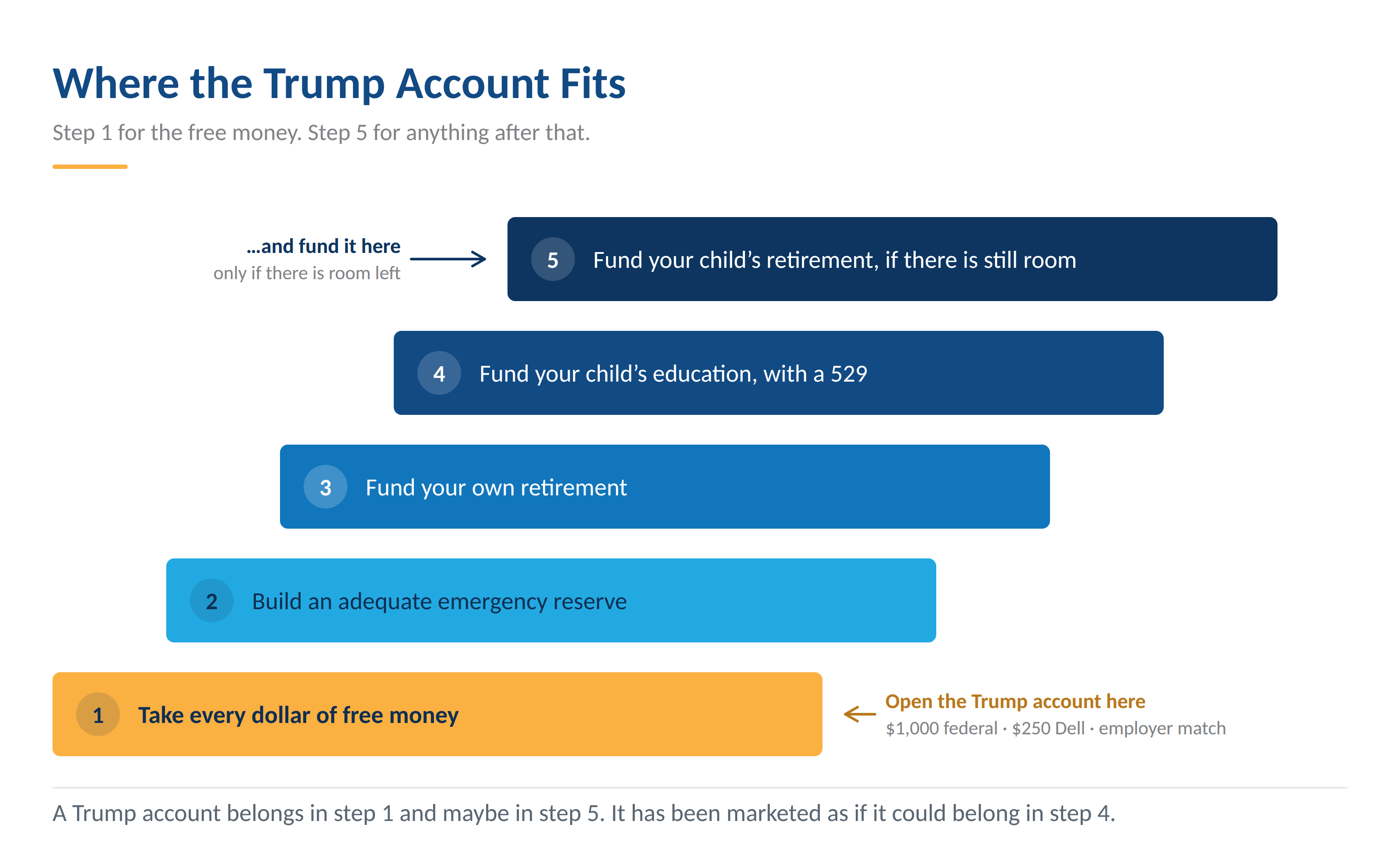
Our framework has four rungs, in this order:
- Take every dollar of free money – the federal contribution, the Dell pledge, and any employer match.
- Establish an emergency fund.
- Fund your own retirement.
- Fund your child's education, with a 529.
- Fund your child's retirement, if there is still room.
The Trump account is a fine tool sitting on the fifth rung. The trouble is that it has been marketed as though it belongs on the third (and sometimes even above the second one). If the goal is education, tax-free withdrawals beat tax-deferred ones, and that gap compounds for eighteen years before anyone spends a dime.
If you would like help fitting these rules into your family’s broader plan, we would be glad to talk it through.
Disclosure: This article is for educational purposes only and should not be considered tax, legal, or investment advice. Tax laws, contribution limits, eligibility requirements, and financial aid rules can change. Consult your tax advisor and financial professional regarding your specific situation.
Source Links
Sources referenced in this article:
CRS: Trump Accounts — Overview and Policy Considerations
Federal Register: Trump Accounts proposed regulations
Treasury: Official launch of Trump Accounts and scope of the app
Treasury: Trump Accounts app launch and next steps