How do you typically spend your days off? When you finally reach a day with no required meetings or work deadlines, how do you fill that space? For many of us, a day off doesn't actually mean rest. It means catching up. Running errands. Tackling projects we've been postponing. Maybe even doing a little extra work so Monday feels less overwhelming.
Our culture has taught us that staying busy is better than doing nothing. Productivity is praised, hustle is rewarded, and rest is often viewed as laziness–or at best, a luxury we earn after everything else is finished. Because of that, rest can feel uncomfortable. Guilt has a way of creeping in when we stop. We wonder if we're wasting time, falling behind, or being irresponsible. But what if rest isn't a failure of discipline? What if it's actually an act of obedience?
When we talk about Sabbath, we usually think about rest; but that word carries a lot of baggage. What comes to mind when you hear "Sabbath"? Maybe rules. Maybe church. Maybe naps. Maybe nothing at all. For some, Sabbath feels like an outdated concepted, disconnected from modern life. For others, it carries memories of rigidity or pressure rather than freedom. Yet Scripture presents Sabbath not as a burden, but as a gift–a rhythm God himself designed for our good.
We live in a world that celebrates the grind. Never taking a day off is often seen as admirable, even virtuous. Taking time to rest can feel risky, especially when there's unfinished work waiting. Have you ever tried to rest while mentally rehearsing everything you still need to do? Have you ever felt guilty enjoying a day off when your to-do list wasn't complete? That tension reveals how deeply we've tied our worth to our productivity.
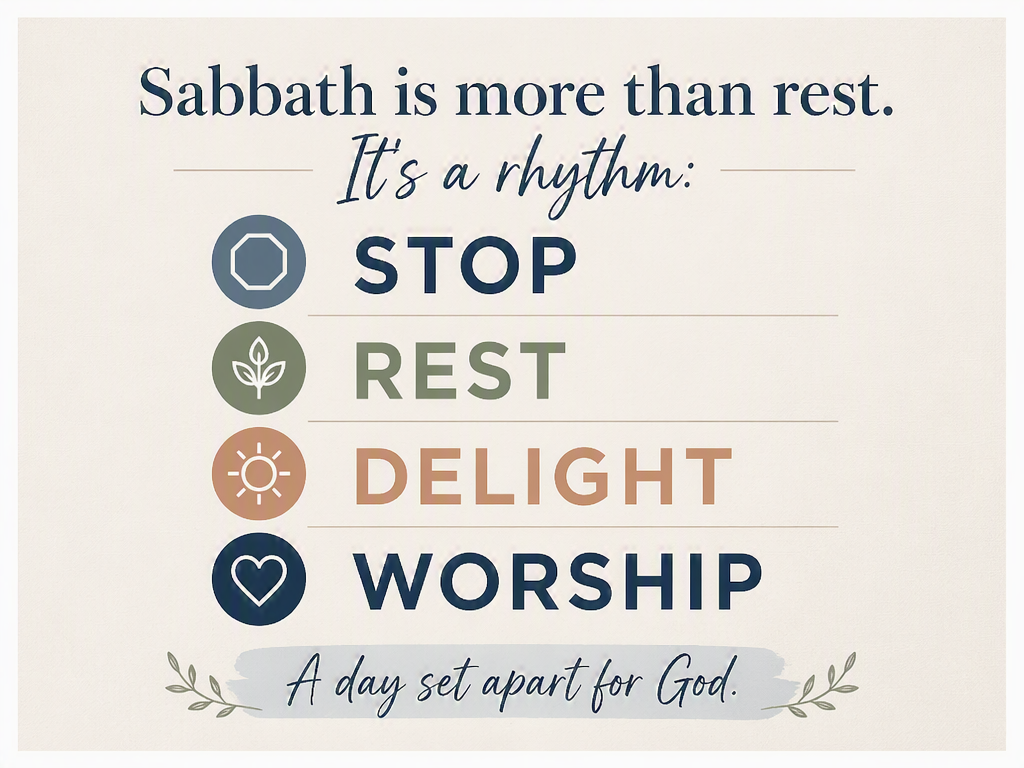
In The Ruthless Elimination of Hurry, John Mark Comer helps reframe Sabbath by walking through four meanings of the word–each inviting us deeper into what true rest looks like.
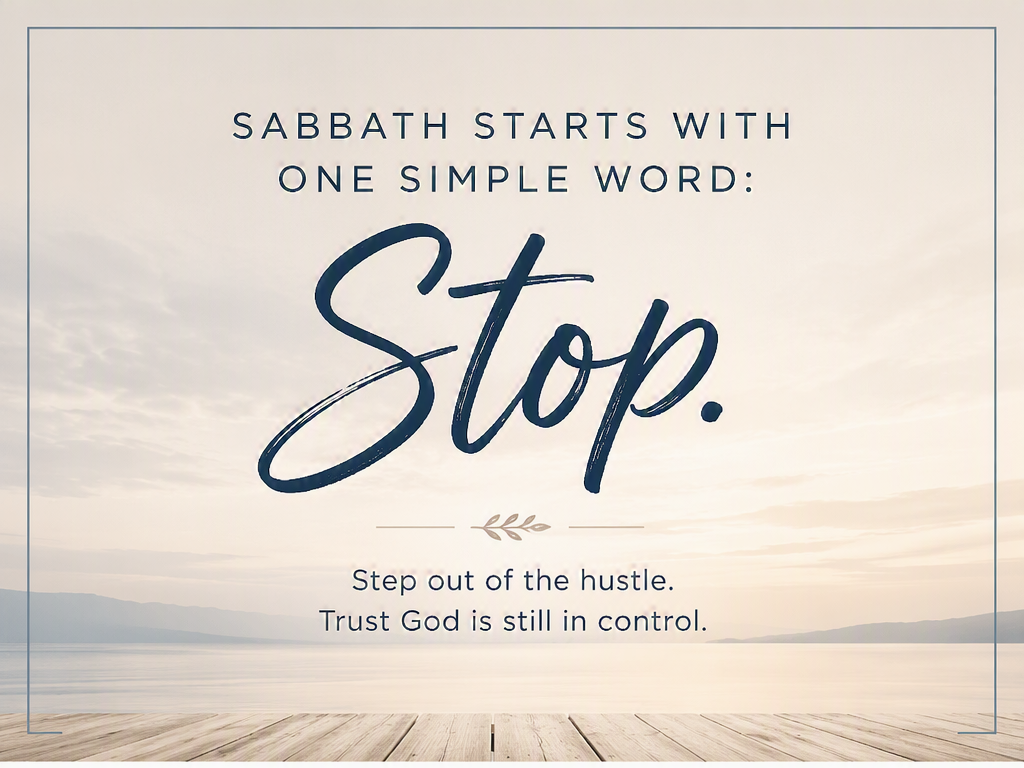
The most literal meaning of Sabbath is "to stop." Sabbath is a day to stop working, stop striving, and stop hustling. That sounds simple, but in practice, stopping can feel almost impossible. What makes it difficult for you to stop, even for a few hours? Is it pressure, fear, habit, or a sense of responsibility that never shuts off? Sabbath invites us to step out of constant motion and trust that the world (and our work) can survive without us for a day.
Stopping is not quitting. It's acknowledging that we are not God. When we stop, we resist the lie that everything depends on us. We declare with our time what we believe in our hearts: God is in control, even when we rest.
The second meaning of Sabbath is rest—not just physical, but mental and emotional rejuvenation. Rest includes sleep, but it goes beyond it. True rest is active trust. It's choosing to set aside problems that need solving and worries that feel urgent, believing God can carry them without our constant attention. John Mark says, "When I rest, I'm not wasting time. If I am, I'm wasting time on God and resting in him."
When was the last time you took a full day away from your normal schedule and responsibilities? Not just a break from work, but a break from planning, fixing, and worrying? What might it look like for you to actively rest in Jesus—to release control instead of just pausing activity?
Sabbath rest isn't about escape; it's about restoration. It's learning to be with God without an agenda.
The third meaning of Sabbath is delight. This is where Sabbath often surprises us. Sabbath isn't meant to feel dull or restrictive. It's meant to feel like a celebration. A holiday. A day that reminds us life is good and God is generous. Sabbath creates space to enjoy God's gifts without rushing past them.
John Mark asks a piercing question: What could you do for a 24-hour period that would bring you deep, soul-level, throbbing joy? That question challenges us to think differently about rest. Not just what helps us recover, but what helps us rejoice.
John Mark explains that his family "pleasure stacks" on the Sabbath—intentionally filling the day with life-giving experiences like fun food, games, and meaningful time together. Delight will look different for everyone, but the invitation is the same. What could it look like for you to "pleasure stack" on your next Sabbath? What activities help you feel fully alive, grateful, and present to God and others?
The final meaning of Sabbath is worship. Sabbath is a day set apart for God. That's why, for many Christians, Sunday has historically been the day of Sabbath. But regardless of which day you choose, Sabbath is about orientation. It's about dedicating time to God, not just attending a service.
Beyond gathering for worship, what might it look like for you to give an entire day to God? What does worship look like outside of singing songs or listening to a sermon? Worship can look like gratitude, rest, delight, silence, prayer, or simply receiving God's love without trying to earn it.
Sabbath matters because it removes distractions, makes us more sensitive to the Spirit, and gives us space to experience the beauty of life. It slows us down enough to notice God again. What could it look like for you to intentionally carve out a Sabbath day once a week? What are you most excited about when you imagine your next Sabbath?
From the beginning, Sabbath has been central to God's design. Genesis 2:1-3 tells us:
Thus the heavens and the earth were finished, and all the host of them. 2 And on the seventh day God finished his work that he had done, and he rested on the seventh day from all his work that he had done. 3 So God blessed the seventh day and made it holy, because on it God rested from all his work that he had done in creation.
Notice what stands out in these verses. God rested. He blessed the day. He made it holy. Out of all the days of creation, only one is set apart in this way. God didn't need rest, yet he modeled it for us. How does God resting from his work shape your understanding of why we need to rest from ours?
Sabbath is not an afterthought, it's woven into creation itself. One day is meant to be different. One day is meant to restore us.
At the same time, Scripture makes it clear that Sabbath is a gift, not a weapon. In Matthew 12:1-14, the Pharisees criticize Jesus for allowing life-giving activity on the Sabbath. Their strict rules valued technical obedience over compassion. Jesus responds by healing a man, revealing the true heart behind the command. Sabbath was never meant to prevent God's provision or keep people from being made whole.
There's no need to feel guilty if an emergency arises on your Sabbath. Being overly strict can actually create stress and harm. In what ways might being too rigid about your off-day cause anxiety in you or pain in others? Jesus' actions show us that the intent of Sabbath is mercy, restoration, and life... not fear or legalism.
The Pharisees tried so hard to protect the Sabbath that they lost its purpose. While boundaries are important, Sabbath should never become a source of pressure. Jesus reminds us that the Sabbath is for our good and for God's glory. We don't need to fear disappointing God if we don't practice it perfectly. God loves us. He has blessed us with a day of rest, delight, and worship.
Keeping Sabbath isn't just a good idea, it's an invitation to trust God with our time. Integrating it into your week may feel challenging at first, especially if regular rest is unfamiliar. Start small. Prepare intentionally. And if your Sabbath doesn't go as planned, that's okay. Try again the next week.
As Jesus says in Mark 2:27,
"The Sabbath was made for man, not man for the Sabbath."
Sabbath is a gift. Learning to receive it may be one of the most countercultural and life-giving choices we can make.